हिंदी दिवस

हिंदी दिवस

14 सितंबर – 2020

भारत में, ‘राष्ट्रीय हिंदी दिवस’ प्रति वर्ष 14 सितंबर को मनाया जाता है। 14 सितंबर 1949 को हिंदी को भारत की राजभाषा के रूप में अपनाया गया था। तब से हर साल 14 सितंबर को भारत में और विदेशों में स्थित सभी केन्द्रीय सरकारी कार्यालयों में हिंदी दिवस के रूप में मनाया जाता है।

हिंदी भारत की आधिकारिक भाषा है। हिंदी भाषा सभी भारतीयों के बीच सौहार्द्र और एकता की भावना को जागृत करती है। भारतीय संविधान के अंतर्गत अनुच्छेद 343 के अनुसार हिंदी को भारतीय संघ की राजभाषा का दर्जा प्रदान किया गया है। हिंदी दिवस के दिन हिन्दी को बढ़ावा देने के लिए कई कार्यक्रम देश भर में आयोजित किए जाते हैं। यदि हमें आने वाली पीढ़ी के लिए हिंदी को बचाना है और हिंदी का अस्तित्व बनाए रखना है, तो हमें अधिक से अधिक हिंदी भाषा का प्रयोग करना होगा। और हिंदी बोलने में कभी भी हीनता का अनुभव नहीं करना होगा। गर्व के साथ हिंदी भाषा का प्रयोग करना होगा। साथ ही साथ अन्य भाषाओं को भी महत्व देना होगा परंतु हिंदी को हीन दृष्टि से कभी नहीं देखना होगा। “हिंदी हैं हम वतन है हिंदुस्तान हमारा” इस पंक्ति को साकार बनाना होगा।

एकता की जान है, हिन्दी देश की शान है ।
हिन्दी का सम्मान, देश का सम्मान है ।
हिन्दी का विकास, देश का विकास ।।
हिन्दी भारत माता की बिंदी । हिन्दी है मेरे हिन्द की धड़कन ।
हिन्दी अपनाओ, देश का मान बढाओ ।
हिन्दी-उर्दू भाई-भाई, संस्कृत-हिंदी दीदी-बहन
जो राष्ट्रप्रेमी हो, वह राष्ट्रभाषा प्रेमी हो ।
हिन्दी ही हिन्द का नारा है. प्रवाहित हिन्दी धारा है।
International Literacy Day

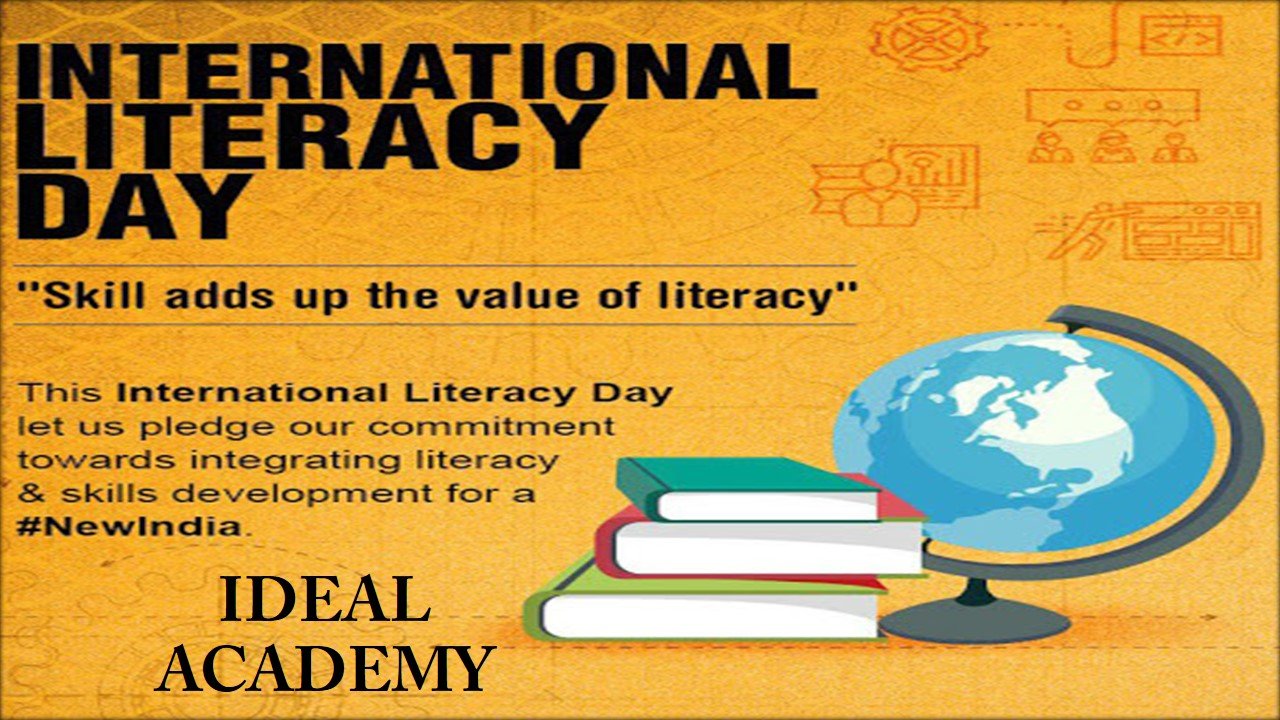
International Literacy Day

08 September – 2020

September 8th marks the International celebration and awareness campaign on literacy. The holiday was declared by the United Nations Educational, Scientific and Cultural Organization (UNESCO) in 1964. Year round UNESCO seeks to keep literacy high on national, regional and international agendas. Through literacy programs UNESCO aims to create a literate world and promote literacy for all.
Today one in five adults (around 796 million) lack minimum literacy skills, with two-thirds of them being women. 67.4 million children throughout the world are not enrolled in school and miss out on basic fundamentals of education.
UNESCO states the importance of literacy on their website:

“Literacy is a human right, a tool of personal empowerment and a means for social and human development. Educational opportunities depend on literacy.

Literacy is at the heart of basic education for all, and essential for eradicating poverty, reducing child mortality, curbing population growth, achieving gender equality and ensuring sustainable development, peace and democracy. There are good reasons why literacy is at the core of Education for All (EFA).

A good quality basic education equips pupils with literacy skills for life and further learning; literate parents are more likely to send their children to school; literate people are able to access continuing educational opportunities; and literate societies are geared to meet pressing development.”

The saddest aspect of India’s literacy statistics is the disproportionate percentage of women who remain illiterate. Sixty per cent of India’s illiterates are women. Female literacy (43 per cent) was 26 percent below the male literacy (69 percent). No society has ever liberated itself economically. Politically, or socially without a sound base of educated women. The two- word mantra to promote development in the world: “educate girls”. Scholarly studies and research projects have established what common sense might already have told us: that if you educate a boy, you educate a person, but if you educate a girl, you educate a family and benefit an entire community.
Certainly, there is no better answer. India must educate itself – achieve 100 per cent literacy nationwide- if we are to fulfill the aspirations we have to dare to articulate, and rise to the development challenges of the 21st century.

Teachers’ Day

Teacher's day

05 September – 2020

“The nation is created by the teachers”
Teachers’ day is celebrated to express our gratitude and appreciate the hard work of our Teachers. Teachers’ Day in India is observed on the birthday of Dr. Sarvepalli Radhakrishnan that falls on 5th of September every year.
This great son of India was a teacher and later became the Vice-President of Indian Republic. Dr. Sarvepalli Radhakrishnan was the 2nd President of India.

We, Indians, are proud to pay our respect to that great Teacher-President on this day. We pay our respect to our own teachers as well. Our teachers inspire us the same way as Dr. Sarvepalli Radhakrishnan inspired his students. They love us and are always anxious to help us.

It is widely celebrated in schools and colleges. Occasionally, Students and teachers together arrange a Teachers’ Day Function. They also organize cultural events on this day. Teachers and students gather somewhere inside the school and the celebration begins. But this year teachers and students are going to celebrate Teachers Day virtually with zeal, respect and bond of love not affected due to Covid-19.

We Indians owe more to our teachers than we owe to our parents. Our teachers help us stride forward, build our character and prepare us to face life.

Onam

Onam

31 August – 2020

‘Onam’ is a famous festival of Kerala, India. It is the state festival of Kerala and falls during the month of Chingam according to Malayalam Calendar. According to Modern Calendar it generally falls in the month of August or September. The festival commemorates the Vamana avatar of Vishnu and the subsequent homecoming of the legendary Emperor Mahabali. The Keralites celebrate this festival unitedly without the difference of caste and religion.

Onam is a celebration of Ten days. The festival is marked by various sports and festivities in Kerala, including worshiping, music, dances, sports and boat races. People put flower mats in front of their houses, to welcome the King Mahabali. Onam is celebrated with number of cultural elements. This festival is the most important harvest festival of Kerala. Keralites all over the world celebrate this festival with pomp and gaiety.

National Sports Day

National Sports Day

29 August – 2020
Dhyan Chand Jayanti’ is celebrated in India on 29th August every year. Dhyan Chand was born on 29th August 1905 in Allahabad. His father Sameshwar Dutt Singh was in the British Indian Army. Dhyan Chand was an Indian Hockey player widely considered to be one of the greatest players of all time. He is most remembered for his goal-scoring feats and for his three Olympic gold medals (1928, 1932, and 1936) in field hockey. He is known as “The Wizard” for his superb ball control.

The birth anniversary of Indian hockey legend Dhyan Chand is celebrated in India as ‘National Sports Day’. On this day, various sporting events such as walkathon and football tournaments are held across the country as part of the National Sports Day celebration. The President of India Bestows prestigious awards to the sports persons who have contributed to the growth of sports all through their sports career.

Dhyan Chand’s life teaches us all to be determined and motivated with a zeal to achieve something even in the harshest time. We can truly learn a lot from the late great Major Dhyan Chand.

He said, “When I die, India will not shed a tear for me”. Unfortunately, Dhyan Chand passed away on December 3rd, 1979 due to Liver Cancer. He went to the All India Institute Of Medical Sciences for his treatment, however, he was living on a pension of Rs. 200 and was placed in the general ward because no one recognized him. Well, in a way Dhyan Chand predicted what was about to happen.

It’s sad that such a great and inspirational man who most probably is a role model for a lot of sportspeople met such a sad end. R.I.P and Happy Birthday Major Dhyan ‘Wizard’ Chand.

Mother Teresa Birthday

Mother Teresa Birthday

26 August 2020 –

“Love cannot remain by itself – it has no meaning. Love has to be put into action, and that action is service .” – Mother Teresa

‘Mother Teresa’ was born on 26 August 1910 at Skopje, Macedonia. Her real name was Agnes Gonxha Bojaxhiu. She was the youngest child of Nikollë and Dranafile Bojaxhi. Her father died in 1919 when she was only eight years old.

Agnes was fascinated with missionaries from an early age, and by 12 she knew that she would commit herself to a religious vocation. When she was 18, she left home and joined the Sisters of Loreto in Rathfarnham, Ireland.

Mother Teresa committed to be a nun in 1931 and chose the name Teresa to honour patron saints of Australia and Spain. In 1950, she founded the Missionaries of Charity, a Roman Catholic religious congregation dedicated to serve “the hungry, the naked, the homeless, the crippled and the blind.

Mother Teresa was honored with many awards throughout her life. In the year 1979, Mother Teresa was honored with the ‘Nobel Peace Award’. She later received ‘Bharat Ratna’ (India’s highest civilian award) in 1980.

Mother Teresa died on 5 September 1997 at the age of 87 at Calcutta, West Bengal, India. Her death stunned millions of people all over the world. She was given a state funeral and was laid to rest at Mother House in Calcutta. She is still alive in our hearts and
quotes of mother Teresa still inspire us.

World Humanitarian Day

19 August 2020 –

In December 2008, the sixty-third session of the UN General Assembly decided to designate 19 August as World Humanitarian Day. 19 August is the date on which a brutal terrorist attack on UN headquarters in Baghdad in 2003 killed 22 people, including UN envoy Sergio Vieira de Mello.

The Day also seeks to draw attention to humanitarian needs worldwide and the importance of international cooperation in meeting these needs. Every year, disasters cause immense suffering for millions of people – usually the world’s poorest, most marginalized and vulnerable individuals. Humanitarian aid workers strive to provide life-saving assistance and long term rehabilitation to disaster-affected communities, regardless of where they are in the world and without discrimination based on nationality, social group, religion, sex, race or any other factor.

Humanitarian aid is based on a number of founding principles, including humanity, impartiality, neutrality and independence. Humanitarian aid workers should be respected, and be able to access those in need in order to provide vital assistance. Humanitarian aid workers can be international, but most come from the country in which they work. They reflect all cultures, ideologies and backgrounds and they are united by their commitment to humanitarianism.

Everyone can be a humanitarian. People affected by disasters are often the first to help their own communities following a disaster. Responding to emergencies is only one aspect of humanitarian work. Humanitarian workers also support communities to rebuild their lives after disasters, to become more resilient to future crises, to advocate for their voices to be heard, and to build lasting and sustainable peace in areas of conflict.

Devi Ahilya Bai Holkar Punytithi

Devi Ahilya Bai Holkar Punytithi

18 August 2020 –

“In later days from Brahma came,
to rule our land, a noble dame,
kind was her heart and bright her fame,
Ahilya was her honoured name,” wrote poet Joanna Baillie in 1849 in honour of one of the greatest Maratha woman ruler of Malwa.

Born in the village of Chondi in Jamkhed, Ahmednagar, Maharani Ahilyabai as she was fondly referred to Rajmata Ahilyabai Holkar was the Holkar Queen of the Malwa kingdom.

She was married to Khanderao Holkar in 1733 at the tender age of 8. But distress was quick to befall the young bride when her husband Khanderao was killed in the battle of Kumbher in 1754, leaving her a widow at only 29.

When Ahilyabai was about to commit Sati, her father-in-law Malhar Rao refused to let it happen.

He had been her strongest pillar of support at that time. But a young Ahilyabai could see her kingdom fall like a pack of cards after her father-in-law passed away in 1766, only 12 years after the death of his son Khanderao.

One can imagine how a woman, royalty would suffer after losing her husband, father-in-law and only son. But Ahilyabai stood undeterred. She did not let the grief of her loss affect the administration of the kingdom and the lives of her people.

She took matters into her own hands. She petitioned the Peshwa after her son’s death, to take over the administration herself. She ascended the throne and became the ruler of Indore on 11 December 1767.

The Queen of Malwa, apart from being a brave queen and proficient ruler, was also an erudite politician. She observed the bigger picture when the Maratha Peshwa couldn’t pin down the agenda of the British.

“Far and wide the roads were planted with shady trees, and wells were dug, and rest-houses for travellers were made. The poor, the homeless, the orphaned were all helped according to their needs. The Bhils, who had long been the torment of all caravans, were routed from their mountain fastnesses and persuaded to settle down as honest farmers. Hindu and Muslim alike revered the famous Queen and prayed for her long life,” writes Annie Besant.

She was 70 when she died and was succeeded by her commander-in-chief, Tukoji Rao Holkar I.

According to Besant “Indore long mourned its noble Queen, happy had been her reign, and her memory is cherished with deep reverence unto this day”.

Independence Day (India)

Independence Day (India)

15 August 2020 –

“Freedom is not worth having if it does not connote freedom to err.”
Mahatma Gandhi

The Independence Day of India, which is celebrated religiously throughout the Country on the 15th of August every year, holds tremendous ground in the list of national days, since it reminds every Indian about the dawn of a new beginning, the beginning of an era of deliverance from the clutches of British colonialism of more than 200 years. It was on 15th August 1947 that India was declared independent from British colonialism, and the reins of control were handed over to the leaders of the Country. India’s gaining of independence was a tryst with destiny, as the struggle for freedom was a long and tiresome one, witnessing the sacrifices of many freedom fighters, who laid down their lives on the line.
On this day, India witnesses a huge celebration of independence with tricolor flag hoisting, parades and cultural functions across the country. Independence Day is one of the most significant days in the Indian history that remarks the bravery of our freedom fighters. With buildings illuminated by the tricolor, people pay homage to our leaders and great fighters who fought and gave up their lives for India’s freedom “Our Freedom”. Laid on the sacrifices of many freedom fighters and celebrated with much dedication, the 74th Independence Day on 15th August is a national holiday when people express their happiness by flying kites, listening patriotic songs and hoisting national flag.

To continue with the legacy, this Independence Day will be celebrated online by hosting the tricolor followed by National Anthem, patriotic songs and motivational speeches​ by Students and faculties.

International Youth Day

12 August 2020 –

“The Youth of a Nation are the trustees of Posterity.” – Benjamin Disraeli

International Youth Day seeks to raise awareness to the cultural and legal issues faced by youth throughout the world. The United Nations defines youth as people between the ages of 15 and 24 years, although locally, youth can be interpreted in a more flexible manner.

In 1995, the General Assembly of the United Nations (UN) adopted the World Programme of Action for Youth with the intention of establishing guidelines and policies for action and support that would lead to a brighter future for tomorrow’s youth. The World Programme of Action for Youth, which consists of 15 priority areas, including education, employment, hunger and poverty, health, environment and drug abuse, paved the way for the UN’s declaration of International Youth Day in 1999. Since its inception on August 12, 2000, International Youth Day has served to increase the quality and quantity of opportunities available to the youth to actively participate in society.

In 2009, the UN Economic and Social Council further expanded each of the 15 youth priority areas by developing goals and targets for monitoring youth progress, an expansion that now serves as the basis for International Youth Day’s annual theme. Each year, the theme is selected based upon immediate and relevant issues that youth are facing today. The youth is leading the change, and International Youth Day ensures that they have the ability, skill, motivation and recognition to continue to do so.